


On a typical Monday morning in a government office, the hallway fills with people waiting to be served. Inside, an officer moves between stacks of files trying to locate a document needed to approve a request. The information exists somewhere, but finding it takes time.
Later that evening, a bank operations team is still working through reconciliation reports from several systems. Before the next day begins, the numbers have to match. The work is careful and necessary, but much of it is still done manually.
In a fast-growing startup across town, the situation looks different, but the challenge is similar. Institutional knowledge sits in Slack messages, scattered documents, and the memory of the founder who built the company from the ground up.
These situations are common across organizations of every size. They are not caused by a lack of technology. In fact, many of these organizations have invested heavily in digital tools.
The problem runs deeper.
This is not a technology problem.
It is an infrastructure problem.

The African Enterprise Reality
Over the last decade, businesses and public institutions across Africa have adopted software at a rapid pace. Governments launched online service portals. Banks modernized their systems. Enterprises subscribed to platforms designed to improve productivity and communication.
The intention behind these investments was clear: make organizations faster, more efficient, and more responsive.
Yet many organizations still struggle with operational friction.
Research from McKinsey suggests that nearly seventy percent of digital transformation initiatives fail to deliver their intended impact. One reason appears repeatedly in post-implementation reviews: fragmentation.
- Documents live on one platform.
- Approvals move through email
- Operational knowledge sits in disconnected folders.
- Reports arrive hours or days after decisions are made.
The result is a familiar pattern. Teams spend time searching for information, confirming details, or coordinating processes that should already be structured and automated.
This is where many digital initiatives stall. The tools are there, but the operational layer that connects them is missing.
Without that layer, organizations remain dependent on manual coordination.
The consequence is slower decisions, delayed services, and limited visibility into how work actually moves through the organization.

Introducing HarmonyEdge
HarmonyEdge was created in response to this gap.
Rather than building another application to sit alongside existing systems, the goal was to create a foundational layer that connects them. The category is best described as AI Operations Infrastructure.
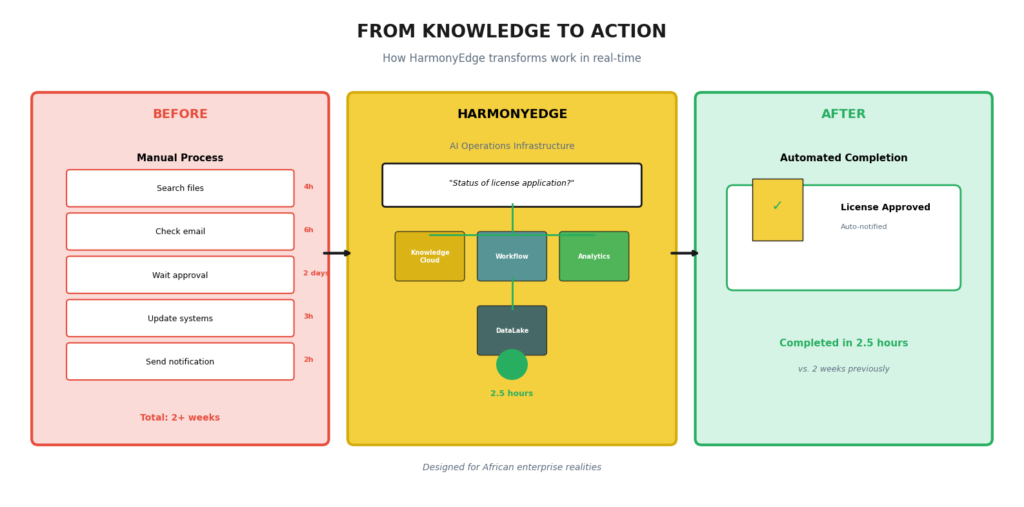
AI operations infrastructure allows organizations to structure knowledge, automate operational processes, and observe performance in real time.
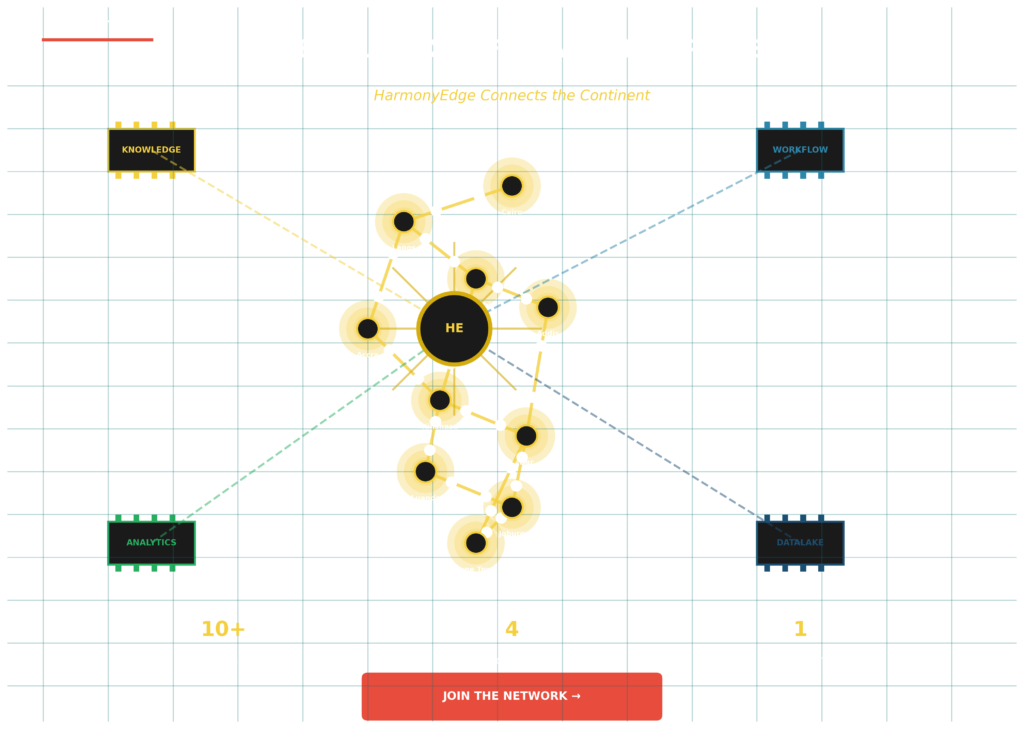
HarmonyEdge brings together four components that make this possible.
The Knowledge Cloud organizes institutional knowledge across documents and internal systems so that information can be retrieved quickly and confidently.
Workflow automation and digital workers allow routine operational tasks to move through structured processes instead of relying on manual coordination. A service request, a compliance check, or a customer case can follow a defined path from start to completion.
Operational analytics provide a clear picture of how work flows across teams. Bottlenecks become visible, performance trends emerge, and leadership can see what is happening inside the organization rather than relying on delayed reports.
Supporting all of this is the DataLakeHouse, which ensures that information entering the system is synchronized, reliable, and governed properly.
Together these layers create a working environment where knowledge informs action and operations can be measured as they happen.
This is infrastructure, not another isolated tool.
And it is designed for the operational realities of African enterprises, where complexity grows quickly as organizations scale.
What We Believe
Africa’s future competitiveness will not be determined by how many organizations experiment with artificial intelligence. The real difference will come from those that turn AI into an operational capability.
Organizations that succeed will share a few characteristics.
- They will be able to learn quickly because their knowledge is structured and accessible.
- They will make decisions quickly because they can see what is happening across their operations in real time.
- They will act quickly because routine work is automated and structured.
- And they will govern effectively because their systems provide transparency and accountability.
Artificial intelligence should do more than answer questions.
It should help organizations complete work, move processes forward, and improve the way decisions are made. When AI becomes part of operational infrastructure, its value compounds over time.
Building the Next Layer of Africa’s Digital Economy
Across the continent, leaders are looking for ways to build organizations that can move faster while remaining accountable and resilient.
Operational AI infrastructure offers a path toward that goal.
- It connects knowledge with action.
- It turns data into operational awareness.
- And it provides a structure for organizations to evolve as they grow.
HarmonyEdge was built with that vision in mind.

Explore Operational AI for Your Organization
Organizations that invest in operational intelligence today will have a significant advantage in the years ahead.
HarmonyEdge offers pilot programs designed to show how AI operations infrastructure in Africa can improve real workflows in government, financial services, and enterprise operations.
If your organization is exploring how artificial intelligence can support day-to-day operations, this is an opportunity to see what that future can look like in practice.
Start a 3–4 week pilot with HarmonyEdge. Book for a Demo today